
The first few days with your newborn can feel like a lot. There is feeding, burping, diaper changes, tiny clothes, very little sleep, and a whole new list of things you are suddenly expected to know.
Somewhere in between all of this, your doctor may also talk to you about newborn screening tests.
Don’t worry. These screenings are a normal part of newborn care. They are designed to look for certain health conditions that may not be obvious when your baby is born, so that doctors can arrange further testing or treatment when needed.
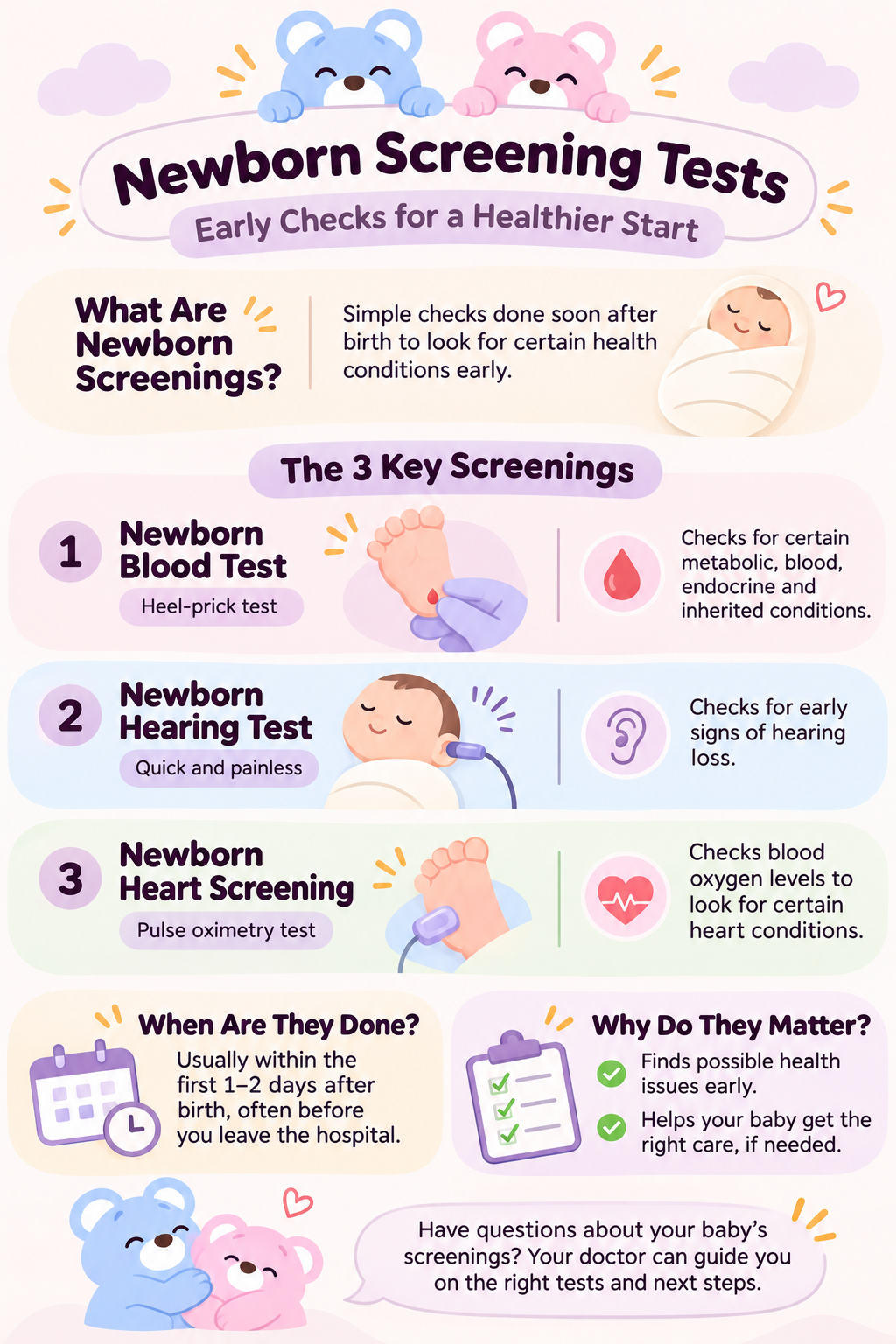
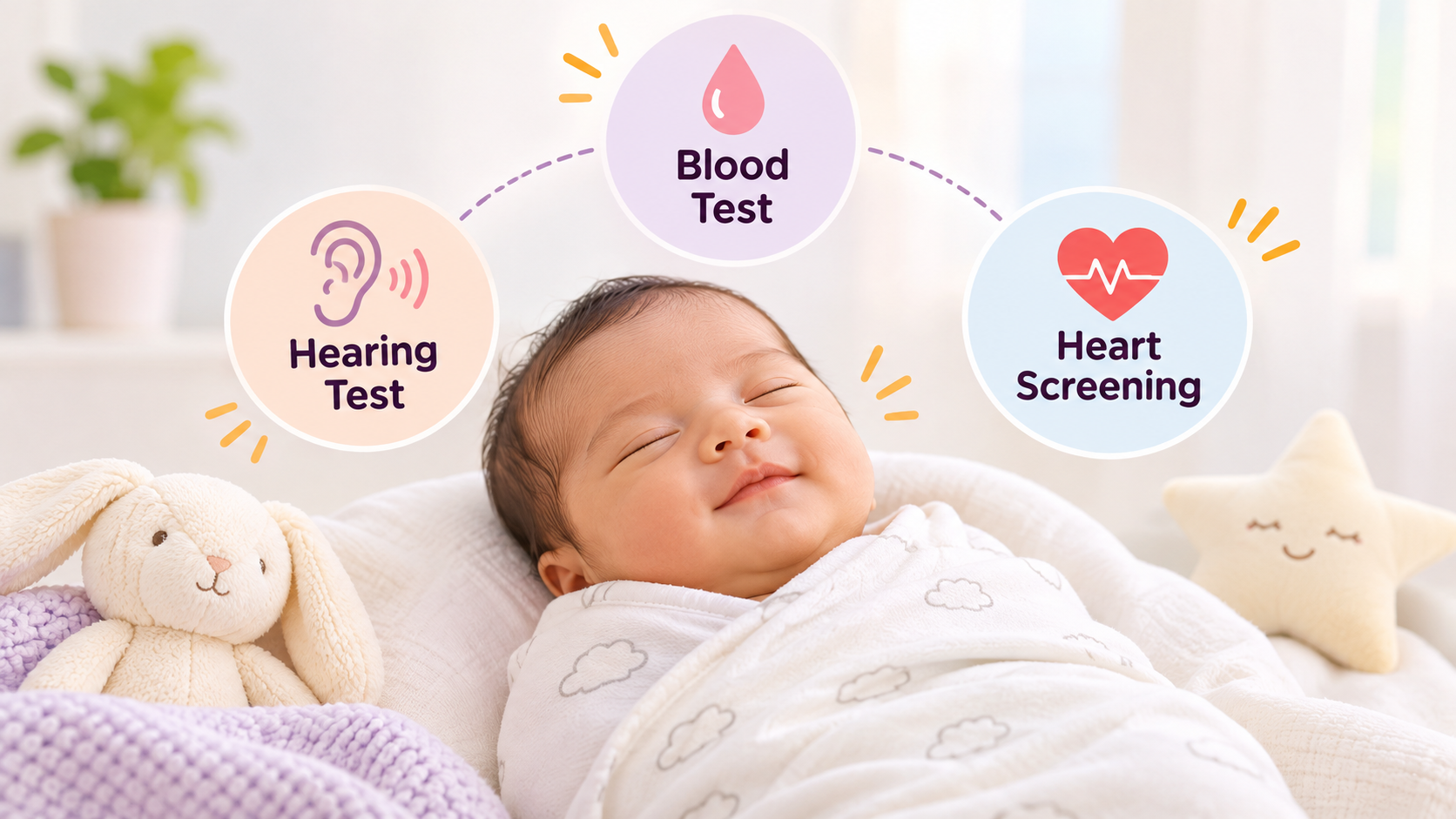
Three important screenings you may hear about are the newborn blood test, hearing screening, and heart screening.
Let’s take a closer look at what each one involves and what you can expect.
What Are Newborn Screening Tests?
Newborn screening is a set of checks performed soon after birth to look for certain health conditions early.
The exact screenings and conditions included can vary depending on where you live, the healthcare system being followed and your baby’s individual needs.
Remember, a screening test is not the same as a diagnosis. If a screening result suggests that your baby may need a closer look, your doctor may recommend another screening or a more specific diagnostic test.
1. Newborn Blood Test
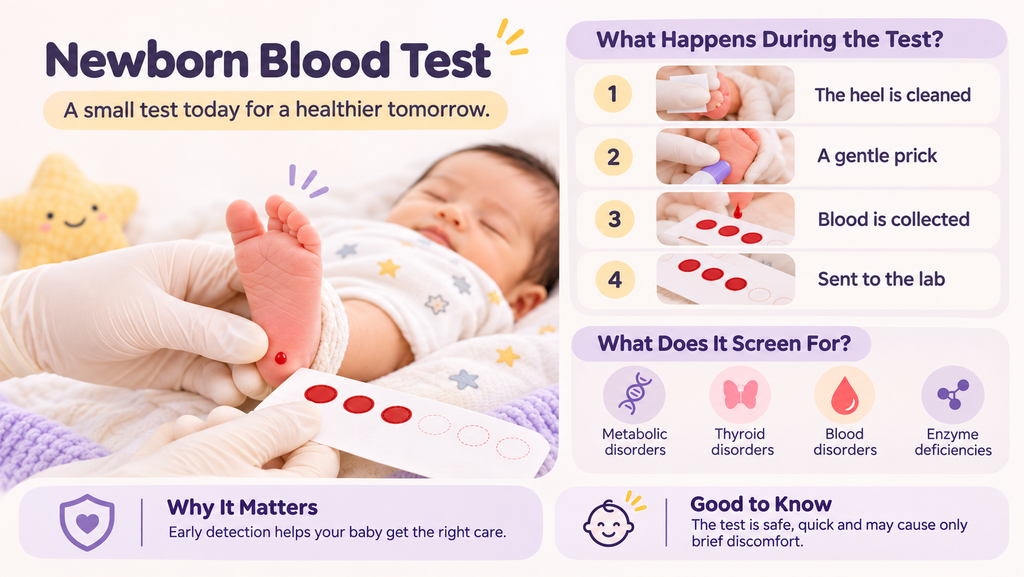
You may also hear this called the heel-prick test.
A healthcare professional gently pricks your baby’s heel and collects a few drops of blood on a special card. They then send the sample to a laboratory for testing.
The blood sample can be used to screen for certain metabolic, blood-related, endocrine, and inherited disorders.
What Happens During the Test?
The actual blood collection is quick. Your baby may cry when their heel is pricked, but the procedure itself does not take long.
The timing can vary, but newborn blood screening is often done within the first 24 to 48 hours after birth. Babies who are premature or unwell may need a different screening schedule.
What Does It Screen For?
The purpose is to identify certain conditions that may not cause noticeable symptoms in the first few days of life.
Finding a potential problem early can give doctors the opportunity to arrange further testing and, when needed, start appropriate care sooner.
And remember, an abnormal screening result does not automatically mean your baby has a disease. It means that further evaluation may be needed.
2. Newborn Hearing Test
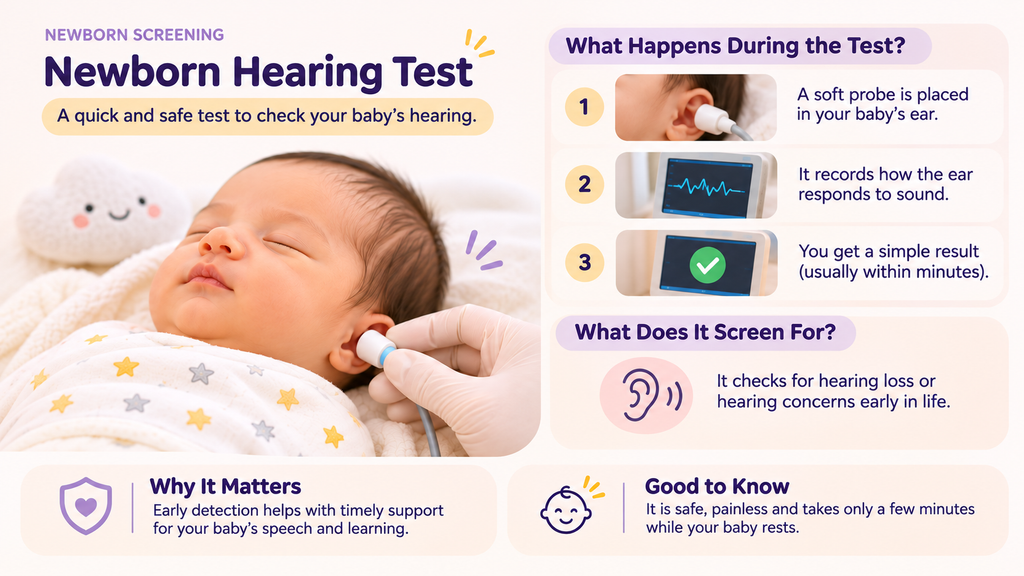
Your baby’s hearing is usually checked soon after birth too.
Unlike the blood test, there are no needles involved. A small piece of equipment is placed gently in or around your baby’s ear while the device plays sounds and measures your baby’s response.
Your baby can usually be asleep during the screening, which is helpful because newborns are not exactly known for following instructions!
How Is the Hearing Test Done?
Two commonly used screening methods are otoacoustic emissions, or OAE, and automated auditory brainstem response, or AABR.
Both are non-invasive. The equipment checks how your baby’s hearing system responds to sound.
The screening generally gives a simple result such as “pass” or “refer.”
What Happens If the Baby Does Not Pass?
A result that requires another test does not necessarily mean your baby has hearing loss.
Sometimes a baby may need to be screened again, and your doctor may recommend additional hearing tests if needed.
The important thing is to follow up when your healthcare provider recommends it. Early identification of hearing concerns can help make sure your baby gets the right support as early as possible.
3. Newborn Heart Screening
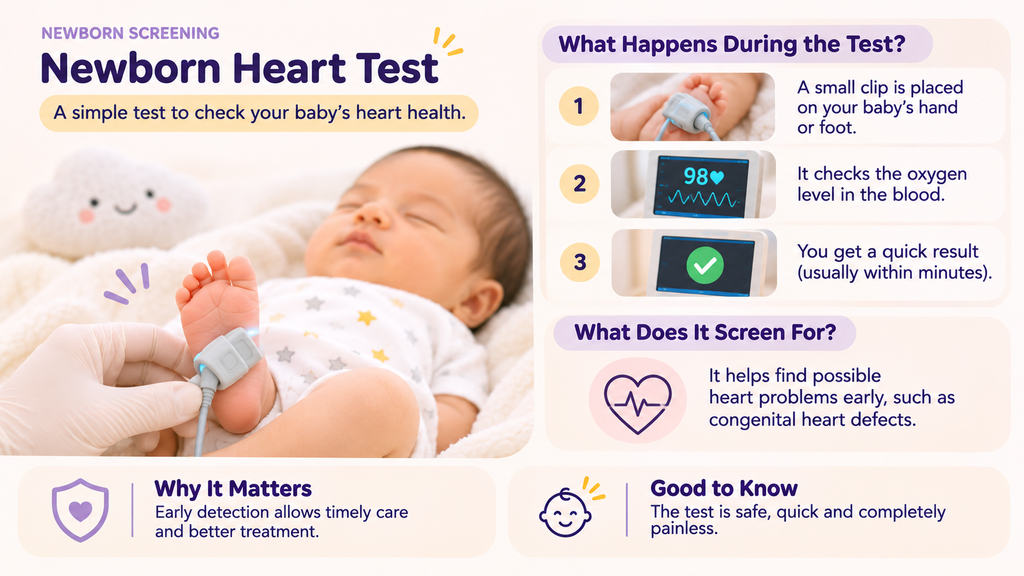
The third important check looks for signs of certain serious heart conditions that may be present from birth.
This screening is usually done using pulse oximetry.
It sounds complicated, but the test itself is quite simple.
A small sensor is placed on your baby’s skin, usually on the hand or foot. It uses light to measure the amount of oxygen in your baby’s blood.
There are no needles involved, and the test usually takes only a few minutes.
How Does Pulse Oximetry Work?
Pulse oximetry looks at your baby’s oxygen level and can help identify babies who may need further evaluation for certain critical congenital heart defects.
If the result is concerning, the healthcare team may carry out additional examinations and diagnostic tests, such as an echocardiogram.
What Does the Screening Check?
Pulse oximetry is a screening tool, not a complete heart examination.
A normal result is reassuring, but it cannot detect every possible heart defect. If your doctor notices other signs or has concerns about your baby’s health, additional testing may still be recommended.
When Are Newborn Screening Tests Done?
Many newborn screenings are completed during the first couple of days after birth, often before you and your baby leave the hospital.
However, the exact timing can vary depending on:
- Your baby’s health
- Whether your baby was born prematurely
- Whether your baby needs care in the NICU
- The screening programme followed by the hospital
- Whether a test needs to be repeated
If a particular screening was not completed before discharge, simply ask your pediatrician when it should be done.
What Happens If a Screening Result Is Abnormal?
This is probably the part that worries parents the most.
First, take a breath.
A screening result is not a diagnosis. Screening tests are designed to identify babies who may need a closer look. Sometimes a result may be affected by factors such as timing or your baby’s individual circumstances.
Depending on the screening, your doctor may ask you to repeat the test or arrange a diagnostic test.
The most important thing is not to ignore the follow-up.
If your baby’s doctor recommends another test, ask what it is for, when it should be done, and when you can expect the results.
Do Premature, or NICU Babies Need Additional Screening?
Sometimes, yes.
Premature babies and babies who need care in the NICU can have different screening requirements or timelines.
For example, some blood screenings may need to be repeated, and babies who spend longer periods in the NICU may have additional hearing screening considerations.
Your healthcare team will guide you based on your baby’s health and circumstances.
Questions to Ask Before Leaving the Hospital
Before you head home with your tiny new roommate, it is worth asking a few simple questions:
- Have all of my baby’s newborn screenings been completed?
- When will we receive the results?
- Does my baby need any screening repeated?
- Do we need any follow-up appointments?
- Is there anything we should watch for at home?
You don’t need to remember everything the doctor says in those first few days. Write the information down if you need to.
Final Thoughts
Your baby’s first few days come with a surprisingly long checklist.
Newborn screening tests may feel like just another thing to keep track of, but they are an important part of checking your baby’s health early.
The blood test, hearing screening, and heart screening each look at different things, and each has its own purpose and limitations.
So before leaving the hospital, ask what screenings your baby has had, whether any need to be repeated, and when you can expect the results.
Then, once the medical questions are answered, you can get back to the really important stuff: feeding your baby, changing those impossibly tiny diapers, getting some rest, and enjoying all those newborn cuddles.
Facts Sourced From: https://www.ncbi.nlm.nih.gov/books/NBK558983/
This article is for general information only and is not a substitute for professional medical advice. Please consult a doctor for proper information on tests required for your baby.